3rd International Conference on Aerospace and Mechanics (ICAM 2026) Concludes Successfully in Shenyang

The 3rd International Conference on Aerospace and Mechanics (ICAM 2026) was successfully held in Shenyang from July 3 to 5, 2026. Hosted by the Liaoning Society of Theoretical and Applied Mechanics and organized by Northeastern University, the conference was co-organized by nine institutions — Harbin Institute of Technology, Dalian University of Technology, Jilin University, Shenyang Aerospace University, Shenyang University of Technology, Shenyang Jianzhu University, Dalian Polytechnic University, Northeast Electric Power University, and the Shenyang Institute of Automation of the Chinese Academy of Sciences — and supported by Shenzhen Sans Zongheng Technology Co., Ltd., Zhejiang Shunhui Optical Technology Co., Ltd., Shanghai Tingtian Information Technology Co., Ltd., Shanghai Feilaishi Technology Co., Ltd., Shenyang Hongsheng Boyuan Technology Co., Ltd., and the China Orient Institute of Noise and Vibration.
Centering on frontier themes such as aircraft design, aerodynamics, advanced materials and structural mechanics, and intelligent propulsion, the conference brought together experts, young faculty members, graduate students, and student representatives from universities, research institutes, and enterprises. Participants gathered in Shenyang to share research outcomes and discuss interdisciplinary integration and the high-quality development of the industry.
Opening Ceremony: Uniting Academic Strength for Aerospace–Mechanics Integration
At the opening ceremony, Hao Jianshan, Party Secretary of the School of Mechanical Engineering and Automation at Northeastern University, delivered a welcome address. Secretary Hao welcomed the experts and young researchers in attendance and noted that ICAM has grown steadily since its inaugural edition was organized by Northeastern University in 2024. Over the past three years, the conference has brought together intellectual strength in aerospace and mechanics from China and abroad, gradually becoming an important platform for academic exchange, knowledge sharing, and collaborative innovation.
Secretary Hao pointed out that the field now faces new challenges including intelligent flight, green aviation, novel aircraft design, and mechanics under extreme environments. This year’s conference would focus on frontier topics such as aircraft design, aerodynamics, advanced materials and structural mechanics, and intelligent propulsion, facilitating exchanges on the latest research findings and engineering practice to jointly drive the high-quality development of the industry. With Shenyang’s deep and vibrant industrial heritage, he expressed the hope that participants would deepen their exchanges, build friendships, and reap rewarding results during the conference.
Keynote Presentations: Advanced Materials, Intelligent Design, Structural Dynamics, and Aviation Frontiers
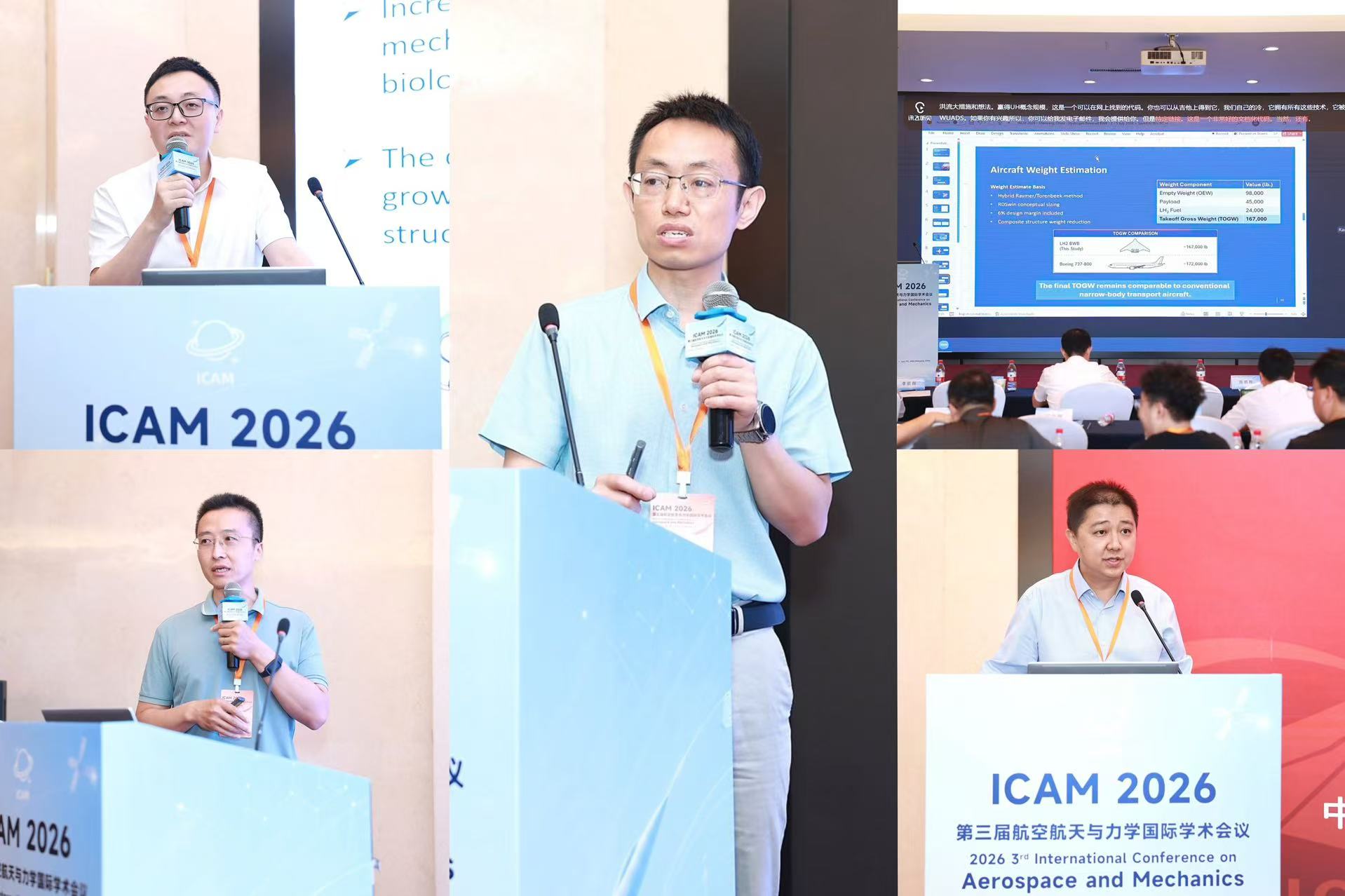
Five invited experts delivered keynote presentations at this year’s conference:
Prof. Chen Minghui, Northeastern University — “Design and Application of Metal-Based Self-Lubricating Composite Materials via Oxidation Regulation”
Prof. Zhao Zilong, Beihang University — “Interdisciplinary Computational Morphogenesis for Structural Form-Finding of Complex Systems”
Assoc. Prof. Han Qinkai, Tsinghua University — “Dynamic Characteristics Analysis and Intelligent Monitoring of Porous Polymer Bearing Cages for Aerospace Applications”
Prof. Ramesh Agarwal, Washington University in St. Louis — “Design of a Hydrogen-Powered Blended-Wing-Body Aircraft for Medium-Range Transport”
Researcher Li Kaixiang, Aircraft Strength Research Institute of China — “Life Prediction, Optimization, and Verification of Aircraft Structures under Thermo-Acoustic-Vibration Loading”
Spanning advanced materials design, interdisciplinary intelligent structural generation, aerospace bearing dynamics monitoring, hydrogen-powered aircraft design, and structural life prediction under thermo-acoustic-vibration loading, the five presentations bridged fundamental theory, key technologies, engineering applications, and frontier exploration. They responded to the real-world demand for lightweight, intelligent, and highly reliable aerospace equipment, while demonstrating the growing convergence of mechanics with materials, computation, and energy.
Parallel Sessions: Three Tracks Showcase the Depth and Breadth of the Disciplines
The conference featured three parallel sessions, in which 19 invited speakers from Harbin Engineering University, Tongji University, Shanghai Jiao Tong University, Beihang University, the National University of Defense Technology, Xi’an Jiaotong University, Beijing Institute of Technology, the Institute of Metal Research of the Chinese Academy of Sciences, Northeastern University, and Yanshan University delivered in-depth talks on three major directions:
Dynamics and fault diagnosis of aerospace equipment, focusing on intelligent diagnostics, fault prognosis, and dynamic modeling.
Vibration and noise control of aerospace structural systems, covering structural vibration suppression, noise control, and composite-material damping.
Advanced aerospace materials and structures, intelligent manufacturing, operation and maintenance, and reliability, addressing advanced material preparation, intelligent manufacturing processes, and reliability evaluation.
By integrating methods from mechanics, materials, control, and artificial intelligence, the sessions reflected the inclusiveness and frontier orientation of ICAM at the intersection of aerospace and mechanics. Lively on-site discussions revolved around research approaches, methodological applicability, and pathways to engineering implementation, offering young scholars valuable inspiration for refining their research.
Oral Presentations and Awards: Diverse Topics Highlight the Vitality of Young Researchers
During the oral presentation sessions, young scholars from the National University of Defense Technology, Beihang University, Tsinghua University, Beijing University of Technology, Qingdao University of Science and Technology, Shenyang University, and Nanjing Normal University reported on a wide range of topics, including unsteady phenomena in hypersonic inlets, airfoil flow-field prediction, the mechanics of intelligent gradient origami structures, carbon-fiber honeycomb reinforcement, rolling-bearing fault diagnosis, and the vibration and impact behavior of composite materials. Their presentations highlighted the innovation and vitality of young researchers at the frontiers of aerospace and mechanics.
The conference also presented awards for outstanding papers, outstanding posters, and outstanding oral presentations, in recognition of scholars whose research stood out in their respective fields.
Looking Ahead: The Conference Ends, the Exchange Continues
The successful convening of ICAM 2026 provided a high-quality platform for experts and scholars in aerospace, mechanics, and related interdisciplinary fields. With 24 invited speakers from China and abroad sharing frontier research findings, participants noted that the program closely matched industry needs in intelligent flight, green aviation, novel aircraft design, and extreme-environment mechanics. The conference not only broadened academic horizons but also fostered collaborative dialogue across disciplines, institutions, and fields.


ICAM 2026